


Let’s Make a Survival Game


I had an idea for a survival game.
I have played a lot of survival games, and there are things I love about them and things that drive me crazy. I like being dropped into a world with very little and having to figure out how to stay alive. I like building a shelter, finding food, exploring, and slowly becoming more capable. What I don't like is when survival becomes mostly inventory management, following glowing quest markers, or killing the same zombie for the four hundredth time.
So I asked Ace a fairly simple question. (If you are new here, Ace is the name my AI Agent chose for itself two years ago when I started playing around in ChatGPT. It makes having brainstorming conversations feel more natural. No, I don't think Ace is a real person.)
I asked: Could you teach me how to make a survival game in Unreal Engine?
As usual, Ace was on top of it. And then the questions started. I’ve used Unreal Engine before, so I was eager to jump in and start building there, but first we needed to know what we were building.
First We Needed a World
The original idea was pretty simple. You are alone somewhere in the wilderness after civilization has fallen apart. You don't have much equipment. You need water, food, shelter, and eventually some idea of what happened.
So... What happened?
Zombies solve a lot of problems for a survival game. They explain why cities are abandoned. They give you enemies to fight. They create danger when you explore buildings. Everybody immediately understands the rules.
I like zombie games, but I didn't really want to make another one. Half the catalog of survival games revolve around hungry brain-gobbling undead. If I was going to spend a year or more trying to learn how to make a game, I wanted the world to at least feel like something original.
So we started poking at other ideas.
Maybe civilization collapsed because of an environmental disaster, a biological catastrophe, a government experiment, or a dozen other scenarios. We knew the non-human enemies wouldn't be zombies, but we wanted something other than humans to be a threat.
That led us to The Changed.
The Changed were human enough that you could tell they had once been people, but something had happened to them. The idea eventually connected to a secret government facility we jokingly called Area 57, where experiments involving human and other mammal genetics had gone very wrong.
That explained The Changed. Then we made the mistake of trying to explain everything else.
How Exactly Did the World End?

Once you start trying to explain the apocalypse, you discover that ending civilization convincingly is surprisingly complicated.
It isn't enough to say something terrible happened. Modern civilization has governments, militaries, hospitals, communications networks, supply chains, emergency systems, and millions of people who are all going to react to whatever is happening.
For a while, we went down a rabbit hole trying to explain exactly how the world ended. If The Changed escaped from Area 57, why couldn't the military stop them? How big was the quarantine? How did it cross the Canadian border? Why didn't somebody evacuate everyone? What happened to electricity and the internet? Why weren't there helicopters flying around shooting these things?
Every answer created two more questions.
For a while this became its own project. We were no longer designing a survival game. We were apparently conducting an analysis of the end of the world.
We came up with government containment efforts. We talked about a quarantine zone near the Canadian border. We imagined Canada sending people to help. We started thinking about what abandoned military positions might look like and what evidence they would leave behind.
Then we eventually realized we don't actually have to explain everything.
Just like in a horror movie, nobody says “Where's the Missing Persons Report? Why didn't they just get in the car? Their parents really let them all go to the woods alone?” The player is one person standing in the woods years after something terrible happened. They don't have access to a classified government report explaining the collapse in chronological order.
They might find an old newspaper asking whether a government experiment had gone wrong. They might discover an abandoned observation post. There could be a line of cars from a failed evacuation. Somebody's journal might tell one version of what happened. Crazy Bob might tell another.
There might even be a skeleton next to a sign that says THE END IS NEAR.
The player can put the pieces together.
Or not.
That actually made the world more interesting. Area 57 could explain where The Changed came from without necessarily explaining why the entire world collapsed. Maybe The Changed caused it. Maybe they were only one part of something much bigger. Maybe civilization was already falling apart.
We didn't need a cutscene explaining the apocalypse. We needed a world that looked like something had happened.
Then We Started Adding People

At some point our lonely survival game stopped being very lonely.
We started inventing settlements. There could be small groups of survivors scattered around the map, each solving problems differently. One settlement might have medical knowledge. Another might have people who knew how to repair things. There could be trading between them.
Then we started talking about languages. What if one settlement had descended from a French-speaking Canadian group trapped inside the quarantine?
What if another group spoke Spanish? Could language itself become part of exploration? Could you learn enough from people, books, or context to communicate with a settlement that initially didn't trust you because you didn't speak their language? Could we reward people who did speak that language by giving them early access to a settlement?
Then it spiraled quickly. We added factions, an economy, quests, professions, and teachers. The world wasn't just a survival sandbox anymore. It was becoming a functioning post-apocalyptic society simulator where different communities had resources, specialties, relationships, and problems.
And I still hadn't opened Unreal Engine.
At Least the Survival Part Was Staying Simple
It wasn't.
I wanted survival to feel real and logical. In a lot of games you can somehow carry six rifles, a stack of lumber, three cooking pots, twenty gallons of water, and half a deer because all of those things have been converted into little squares in an inventory screen.

I didn't want that.
If you have a backpack, and you won't even start the game with one, it should hold a limited amount of stuff. You have a belt. You have your hands. Maybe you can sling a bow or one long tool over your back.
If you are carrying a big container of water and suddenly pull out your knife because something is chasing you, you should drop the water and it stays where you dropped it. Hopefully you remember to go back and pick it up.
We talked about eventually giving the player things like a wheelbarrow so hauling supplies became easier. We talked about limiting how many long tools could physically be carried. We started thinking about what happens when a bow, shield, rifle, axe, or backpack all want to occupy the same physical space on a human body.
This was probably the moment when I should have remembered that I still did not know how to make a character walk forward. I didn't, of course. I was chasing this pipe dream all the way to the end.
If You're Going to Survive, You Should Actually Learn Something
Introducing... Crazy Bob.

Bob broadcasts a radio program twice a day, at six in the morning and six at night. Nobody is completely sure where Bob is, but he knows how to survive.
His broadcasts aren't just game instructions. They are actual survival lessons.
Bob might explain why getting wet in cold weather is dangerous, how to think about shelter, what to look for when tracking an animal, or why a particular way of building a fire works.
The player also begins with a survival field guide. Important things you learn can end up in the guide so you don't have to remember everything Bob said three real-world hours ago.
This became one of the things I liked most about the project.
Some lessons don't even need to serve a complicated game mechanic. Navigation is useful in the game and we would keep an actual fog-of-war map, but learning basic navigation is also just useful. Weather can affect gameplay, but Bob can also explain how someone in the real world might recognize that conditions are changing.
At one point we even talked about trying to get a real survival influencer to play Bob, or maybe appear as themselves in the game and name the field guide after them. That is definitely a problem for Future Dave, though. If we ever try it, it will be after there is enough of the game built to actually show someone.
One important thread that stuck through the whole planning stage was to keep the information accurate. If I am going to make a game about surviving in the wilderness, I would like somebody to finish the game knowing a little more about actually surviving in the wilderness.
Then We Needed Wildlife
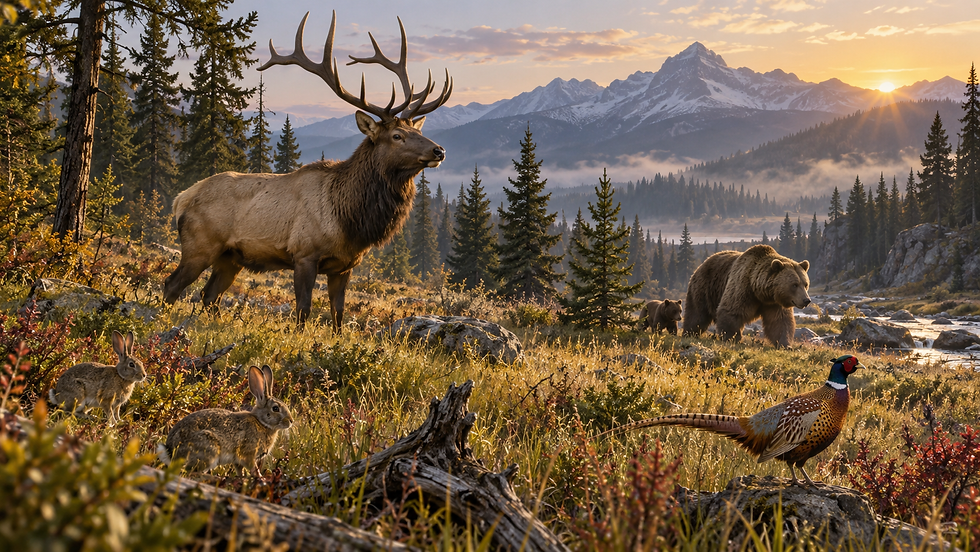
Obviously there had to be animals. Deer, elk, moose, bears, and whatever else made sense for the region. But I didn't want them randomly appearing twenty feet away from the player. I didn't want there to be a squirrel in tree 418 just because I had placed it there.
Encounters would come from a random encounter table: animal, bandit, or The Changed. The game could check periodically to see whether something should happen nearby, but the plan was always to make sure nothing simply dropped directly on top of the player. There should be distance, warning, and some indication that something was happening before the encounter reached you.
An animal might begin with a distant sound. A bandit might be spotted moving between trees or leave signs that someone had passed through. The Changed might be heard before they were seen.
If the encounter was an animal, you might find tracks, scat, trampled grass, broken brush, claw marks on a tree, or blood if it had been wounded. Those clues could lead you toward the animal, or warn you to stay away. That means we need a tracking system.
The same basic idea could apply to bandits and The Changed. Encounters should feel like things happening in the world, not enemies being spawned directly in front of the player.
We Also Needed Time, Weather, and the Moon Apparently

The game day became forty-five real-world minutes, with changing seasons, daylight, and lunar phases. The game would begin under a full moon, reach its darkest nights around the middle of a thirty-day season, and approach another full moon by the next season.
Weather would affect fire and survival. Rain could make fires harder to start or extinguish, while temperature, wet clothing, shelter, and wind affected the player. Water could become unreliable, food could spoil, animals could move, and bandits or The Changed could appear.
The player would have hunger, thirst, temperature, injuries, and other problems to manage.
Somewhere in all of this, I'm pretty sure the phrase "poop meter" came up.
We were doing great.

The Game We Were About to Make
By this point our simple first game had settlements, factions, multiple languages, trading, quests, realistic inventory, hunting, tracking, random encounters, bandits, The Changed, real survival lessons, a field guide, a fog-of-war map, changing weather, seasons, daylight, moon phases, food spoilage, injuries, an apocalypse mystery we had deliberately decided not to explain and maybe a poop meter. There was also supposed to be a larger story for people who wanted one and a pure survival sandbox for people who didn't.
It’s finally time to open Unreal Engine. What could go wrong?

Comments