


How I Got Started in Filmmaking
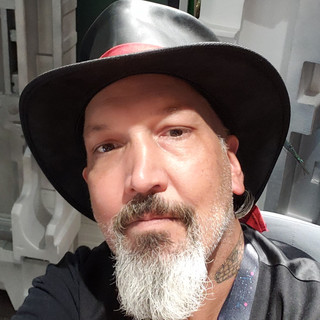

I never thought I would be a filmmaker.
I cut hair for a living. That is still the job. I love it. That is the thing that pays the bills and puts me behind the chair talking to people all day. But somewhere along the way, thanks mostly to my ride-or-die partner Michele and her dangerous habit of saying, “Can you learn this?” I ended up making movies too.
Actually, the more dangerous phrase is, “I have an idea.”
That’s usually how it starts.
The real beginning was virtual production. Michele wanted to try it, and she wanted to know how to use Unreal Engine to make it happen. Unreal Engine is software used to build digital worlds that can be used as backgrounds for films. It’s also used to make video games and a few other things, but virtual production is what I was learning. The easy way I explain what we were trying to do is this: The Mandalorian was shot against a giant LED wall. We are low budget, so we have a fourteen-foot by eight-foot rear-projected screen.
Same basic dream. Much less money.
So Michele asked if I could learn Unreal Engine.
I said sure.
Three days into working through my first four-hour Unreal tutorial, with help from Unreal Sensei, I had built an entire castle scene we could shoot from any angle, inside and out. I’m not saying I knew what I was doing. I am saying there was a castle on the screen, the camera could move around inside it, and suddenly this impossible thing felt a little more possible.
Then came the 48 Hour Film Project.
If you have never done one or heard of it, the 48 Hour Film Project is exactly as ridiculous as it sounds. On Friday night at 7 p.m., every team gets the same required character, prop, and line of dialogue. The prop might be a teacup, the dialogue might be “That’s understandable,” and the character might be Jack or Jane Doe, author. Then each team gets its own genre. It could be horror, musical, sitcom, western, romance, or pretty much anything else they decide to throw at you. Michele wrote a book about it called How We Do a 48 Hour Film Project.
Then you have 48 hours to write the script, shoot the movie, edit it, and submit the final film by 7 p.m. Sunday.

We did one, and afterward Michele said, “I need help editing films. Can you learn Premiere?”
Of course I said yes. I had just built a castle in Unreal and we had used it in a film called A Common Thread. I felt fucking invincible.
Then I opened Premiere.
I hated it.
That is not a professional software review. That is just the truth of my experience. Premiere and I did not get along. I struggled with it, and it felt like I was fighting the software at every step. Every time I wanted to do something simple, it felt like the program had a different opinion about what should happen.
Meanwhile, we were still trying to dial in the virtual production setup. There were artifacts in A Common Thread caused by our Sony camera. The frame rate of the projector made lines in the final film or something like that. I still do not fully understand the technical reason it happened, but the fix was switching to a Blackmagic camera.
Blackmagic RAW, which keeps more camera information in the footage, works better in DaVinci Resolve, so I was asked to learn DaVinci. At that point, I was mostly just going with it. Michele and I were having fun, the project needed another fix, and DaVinci was the next thing to learn.
DaVinci Resolve clicked for me. I found it intuitive. It made sense to my brain. It also did not crash nearly as often as Premiere had for me, which immediately made it more appealing. Suddenly editing was not just the miserable part at the end of the project. It became part of the storytelling. There was a freedom I didn’t feel with Premiere. If you love Premiere, you do you, but I prefer to work in DaVinci.

The first time it really came together for me was a horror comedy called The Last Influencer Standing. The story was about five lying influencers with fewer than 1,000 followers who go on a game show and are promised one million followers if they win. One by one, their lies are revealed, and they start getting killed off, first by the show host and then by each other.
It was ridiculous, dark, and funny. I had a blast. That's the kind of story I love to watch.
I loved building the environment in Unreal. I loved cutting the film together in DaVinci. I really loved cutting in the practical footage from the axe scene I choreographed. I loved watching the pieces turn into something that felt like a real movie. That was probably the moment I stopped thinking of myself as someone helping with film projects and started thinking, okay, maybe I'm a filmmaker.
Since then, we have made a lot of short films. Some worked better than others. Some taught us what not to do. All of them taught us that audio will humble you, lighting will betray you, and a simple idea can become complicated fast once real people, real locations, and real deadlines get involved. And now we are trying to fund a feature-length horror film involving a haunted train car.
That is not where I expected this road to go, but I love it.

Somewhere in all of that, I realized I have a superpower. Maybe we all do, and I just finally noticed mine. I figure things out. I may not be great at sitting in a classroom and getting a degree in film, finance, or forensic accounting, but when there is something I actually want to make, do, or learn, I chase the missing pieces until it starts working. That is how I ended up trying to build an ethical AI image model, too. I wrote more about that here: Ethical AI
Now, this section of the site is where I’ll share the film side of things: what we are making, what I am learning, what broke, what worked, and how a barber ended up building digital sets, editing short films, learning sound design, and trying to help bring a haunted train car to life.
I still cut hair for a living. But now, when Michele says she has an idea, I know I’m probably about to learn another piece of filmmaking, be the muse she needs at the moment, or figure out some other impossible thing.
Comments